Pablo, it’s an honor for MA Magazine to have you in this issue. We feel your work expresses a deep connection between eroticism and sensitivity. In this interview, we’d like our readers to get to know you better and explore your personal path as a Shibari artist. To start, how did you end up in Japan?
Thank you so much for the invitation, and especially for the chance to reflect together on what Shibari is, and how it relates to eroticism and sensitivity. Those are big words. Shibari has a force that goes beyond language, so I hope my wandering thoughts live up to your expectations, and to those of your readers.
As for Japan, I arrived in 2017 for reasons completely unrelated to rope: a job as a researcher at a small artificial intelligence company. Back then, I knew nothing about the rope world, and I could never have imagined that coming here would lead to such a radical change in my life.
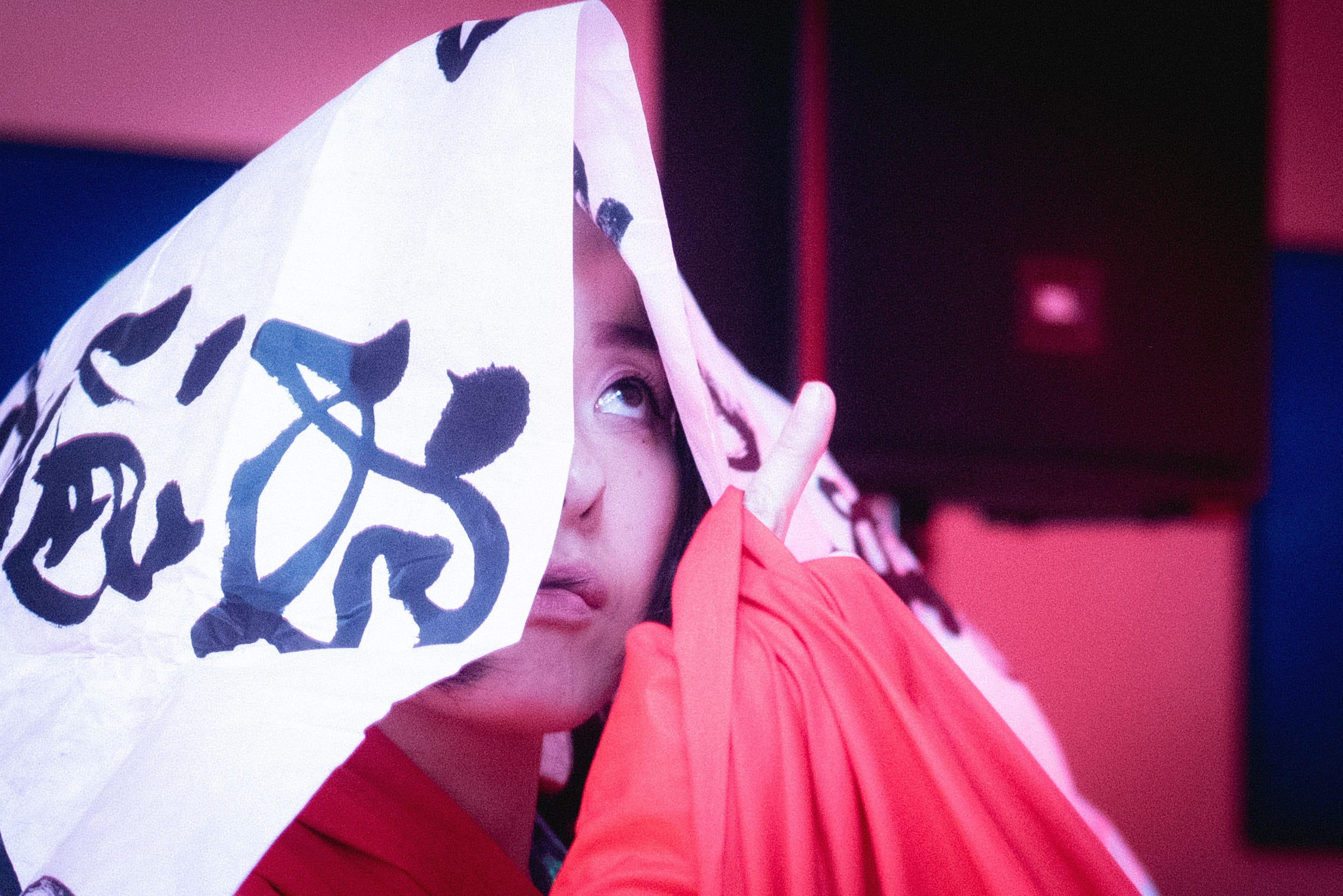
For those who aren’t familiar with Shibari, how would you sum it up?
That’s a difficult question, maybe one without a simple answer. Even though the roots of Shibari reach deep into Japanese culture, as a defined practice it doesn’t have a very long history.
For me, Shibari is simply the art of interacting with ropes. But that definition is about as useful as saying painting is the art of arranging colors on a surface.
For most people, Shibari is about tying, in the sense of restraining someone. In fact, the word “shibari” is a modern borrowing from the verb shibaru (縛る), meaning “to tie,” like tying your shoes. But that feels too narrow. There are many ways to restrain someone that have nothing to do with Shibari, and many ways to do Shibari that have nothing to do with restriction.
Another way to think about it is in relation to Kinbaku (緊縛), which is often associated to sexual connotations and the practice’s origins in the adult entertainment industry. Compared to Kinbaku, many people see Shibari as something broader, an evolution that uses the same techniques with different intentions. That definition is slightly better, but in Japan the term most commonly used is still Kinbaku, which isn’t generally understood as a subset of Shibari.
Of all these related ideas, the one I like most is Musubi (結び), a concept I learned through my friend and admired artist Sayako Shiratori. It’s closer to “knotting” than “tying,” and it carries echoes of Shinto ritual. I wouldn’t dare to define it fully, but I understand Musubi as the interconnection between beings, and it’s the root of beautiful words like kekkai (結界), meaning a boundary that both separates and connects.
This is an idea I aspire to in my work, both in practice and in artistic creation. For me, ropes are an instrument for discovering how we’re part of a greater whole. It’s a hard question.
How did your journey in Shibari begin?
Completely by accident. I had just moved to Japan and was going through a period of transformation where my old identity felt quite dissolved. Someone invited me to a “performance” and I went without really knowing what it was, simply curious to see something new and surprising.
I remember it clearly: a sunny winter day. I arrived at a luxurious home in a quiet suburb of Tokyo. Inside, it was decorated in a traditional style with wood, tatami, and the scent of incense. Two couples sat on the floor in silence, waiting. It turned out it was not a performance at all, but a gathering where several students met with their teacher. I was sitting there, trying to understand what was happening (my Japanese at the time was nonexistent), when a man came over and handed me a rope. My companion knelt in front of me, facing away. Before I could process what was happening, I found myself surrounded by strangers, tying someone I had just met.
The first years were surreal. Shibari was not popular then, especially not in Japan where it still carries a heavy social stigma. The comments I received from people around me made it clear that this was not something I could speak about openly. I have enough anecdotes from that time to fill pages. Even attending class felt like an adventure.
At first I went to these group meetings with the other students, but I soon realised that learning Shibari required a much deeper commitment. For three years I took private lessons once or twice a week, and on the remaining days I practised with whoever was willing. The logistics were complicated, especially in the beginning. At that time there was no community like there is now. The people I tied with were either contacts from the internet or people introduced to me by my teacher. I would meet them in Shibuya, often complete strangers, and we would go together to a hotel to practise.
Looking back, I am touched by my own innocence and I cannot help but smile. What was I doing? I truly did not know. I often wondered why I was dedicating so much time and money to this when there were so many other things I wanted to do in life. I honestly thought Shibari had nothing to do with me, my values, or my philosophical concerns. It was a crossroads shaped by the stigma I mentioned earlier, by the distinction between Shibari and Kinbaku, by its history in the sex industry, and by an image of Shibari that remained on the surface as fetishism.
If I had not been in a period of transition, I do not think I would have allowed myself to go as deeply into it as I did. But there was something in it that pulled me in with a powerful magnetism. Again and again I witnessed the power of rope, its ability to dissolve the distance between me and the world, to dissolve me into the world, and perhaps to dissolve the world itself.
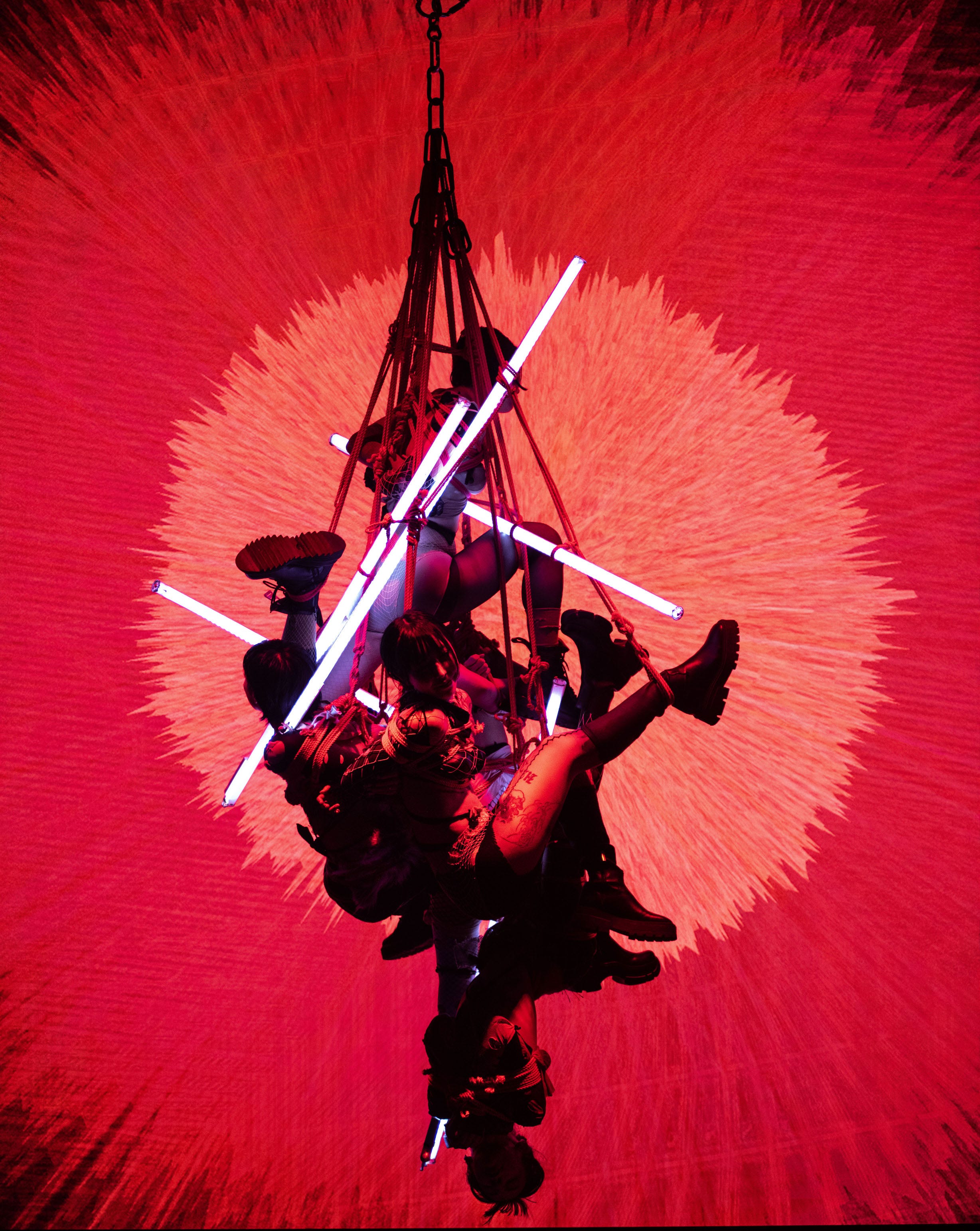
That brings us to UNBOUND, an event of Shibari art with a strong experimental and performative character: techno music, neon lights, a futuristic atmosphere. It is a highly stimulating and innovative sensory experience for participants. How did UNBOUND come to life, and how has it evolved to this day?
About two years in, there was a turning point when I began posting my photographs on social media. Until then I had been documenting my work like a student keeping a record of progress in a diary. As I became more comfortable with my skills and with myself, I started to focus more on the artistic side of what I was doing. Suddenly, people were writing to me to tie, including models and artists I admired. Shibari became a vehicle for exploring and meeting people, and it gradually became part of my identity.
By that time, several years had passed since I arrived in Japan. I was more rooted in the culture and had found my home in the techno and underground community, which is very rich in Tokyo. I was regularly going to open-air music festivals and spending more time at a venue called Bonobo than in my own apartment.
It was during that period that I met Ai (a story for another day), and together we did my first performance at the legendary and now closed club Contact. I am not even sure I would have called it Shibari at that point. It was more of an eruption. And it set off a chain of many other things. From there we were invited to other festivals to work as artists, doing not only performances but also installations. Over the next year we developed more than fifty projects. On weekends we went to rural Japan to create alongside other artists, and during the week we worked in every major club in Tokyo.
In this context, three things happened at the same time that eventually led to what UNBOUND is today. The first was a grant we received from the Tokyo government, intended to encourage artists to digitise their work. In our case, that meant doing a performance and broadcasting it online. Around that time I would occasionally host small gatherings at home to tie with friends, but Japanese houses are very small and ours was no exception. One day, while talking with the owner of Bonobo, the idea came up to meet at the venue instead of my apartment. It seemed like a good opportunity to also do a performance and fulfil our commitment to the city. What began as a gathering with friends ended up becoming a small party at our favourite bar.
Encouraged by this experience, and with the desire to give back to all the organisers who had collaborated with us during such an intense year of work and creation, we decided to hold a thank-you party and launch our art collective, Hidden Layer. We had no experience in event organisation. We did not know how to create a lineup, how much decoration would cost, or what it would take to produce graphic materials and promotion campaigns. I approached the whole process as a gathering with friends, and whenever we did not know how to do something, we simply asked them. When your friends are the organisers of the biggest underground festivals in Japan, the result is something quite extraordinary. It turned out to be the most attended party at Aoyama Hachi that year. A delirious dream that I still remember as if it happened last night.
And of course, we wanted more. We wanted to organise more events, to keep discovering. That summer we met Xan, also known as DJ SuperUser, and decided to create an event together, with him in charge of the music selection. We called it UNBOUND, inspired by the sense of liberation that rope and music share. By then we had already done an event at CUBE, so we decided to return. This time we had a logo and a clear concept: to create a meeting point between the underground scene and Shibari, between experimental art and traditional Japanese art. For me, above all, it was about creating a space where the incredible artists around us could come together to make their magic and to explore what Shibari means, what it means to all be part of the same whole.
When I first saw your work, and unlike other Shibari artists who focus mainly on the physical aspects of the practice, taking it in a more sexual and commercial direction, I sensed a link to the philosophical foundations of Japanese culture. Could you talk more about the philosophy behind your practice and how it connects with Shinto?
I think the philosophical perspective is something I came with by nature. As I mentioned earlier, even in the beginning I spent a lot of time wondering what it was that I was actually doing. I felt that Shibari had a power I could not understand, and which I even rejected from a rational point of view. Where did that power come from, and what did it mean?
What I realise now is that I never approached this question intellectually. Instead of trying to answer it through concepts I did not yet have, I let myself be guided by the desire to keep discovering. Although now I can more or less put words and reasoning behind what I did and thought, in truth it was an emotional and intuitive development. I think it also had to do with being immersed in a culture and language that were not my own, which meant that the tools I had always used to approach the world no longer worked. The fact that the result has a Japanese air, or that it connects with Shintoism, is above all because it was born here, within an artistic community whose spiritual connections are rooted in the spirit of this place. At the same time, it is also true that this spirit resonated strongly with me from the beginning, so I do not think it was entirely by chance.
It is a sensitivity that is difficult to define in words. For me it means, above all, an unlimited respect for the world, for the person I am practising with, and for whatever it is we are creating together. Generally, when we approach a performance, we do it in a completely bare way, letting the context provide most of the content. In the beginning we did have a clear idea we wanted to convey, but over time that idea has been refined until it has almost disappeared. When people come to see us, we want to become a mirror, a reflection of what they already are.
Perhaps said like this it does not make much sense, because in the end what we do is tie and untie, create and destroy, which is to say, nothing. Rope is an excuse to move, and movement is an excuse to be present.
This may be easier to understand in the non-performance side of my practice. It is a less visible facet, but I think it is where the real power of Shibari lies. When someone comes to the studio for a session, they arrive with a set of expectations that I believe are simply impossible to express. Language is something I deeply respect and admire, yet in certain contexts it is fundamentally useless. There is a distance from the world and from ourselves that can sometimes become unbearable. This distance takes many forms, and we all address it in one way or another, and we all explain it to ourselves in one way or another.
When you close your eyes and allow yourself to be carried, when you surrender completely to another person and to whatever is about to happen, when that person receives you from a place of emptiness and without any agenda, I think we can, if only for a moment, experience the illusion that the barrier is not there, or rather, that the barrier is an illusion.
For me, this is the meaning of Shinto. In Japan, when you go to a shrine, you must pass through a torii, the entrance to a path whose arch holds a rope called shimenawa. This rope marks the spiritual realm, not as a barrier but as an entrance between two parts that are one and the same. The binary logic has already disappeared. Although shimenawa today is usually made of rice, it was traditionally made of hemp, one of the most respected materials in Japanese tradition, which is believed to purify just like salt or paper.
I often think about this when I touch a rope that is part of such a threshold, which is essentially a doorway. What is purification? For me, it means dissolving, ceasing to be and at the same time becoming everything. Where my body ends and the body of the other person begins is irrelevant. Space has no meaning, and time has no importance.
There is a strong artistic and aesthetic sensibility in your work. As a designer, and from my own research into Japanese aesthetics, I find it deeply appealing, especially the dialogue between light and shadow and the concept of Ma (space), which we have already discussed in our magazine and podcast. It makes me think of Jun’ichirō Tanizaki’s famous essay In Praise of Shadows. Has this aesthetic developed spontaneously, or is it something you aim to convey intentionally?
As with Shinto, I think the aesthetic in my work has mainly to do with being here in Japan, in a specific context and surrounded by people who are walking a similar path. I understand what you mean, and it is certainly something I value, but I could not say I consciously seek it out. It emerges naturally from simply being here.
Earlier I mentioned the image of the mirror, which is very important to me. One of the things I find most fascinating about artistic practice is its ability to reveal things we could never have imagined. When I start a new project, I like to work with the elements that are already around me, and through experience discover what they mean. I think of the mirror because I see my work as letting things speak for themselves.
In your recent stage performances you have incorporated shodō, Japanese calligraphy. Is this connected to a personal search?
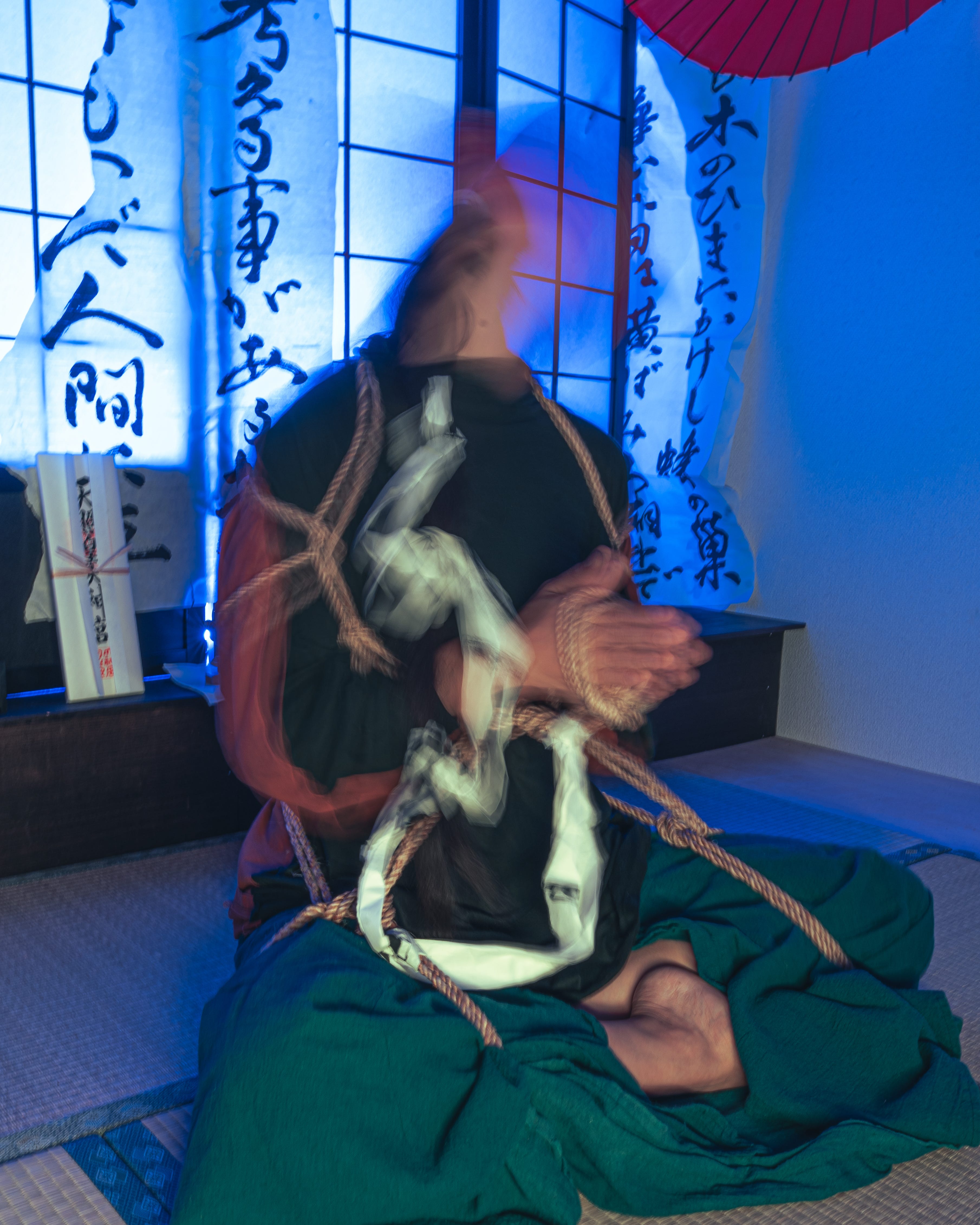
I have been very fortunate to collaborate many times with Garen, an extraordinarily talented calligrapher who is also a Shibari practitioner. The first time we worked together, we focused on calligraphy as body art, using ink to mark the body in the same way rope does. It was a performance based on the story of Hoichi, a blind musician haunted by spirits. According to the legend, a monk covered Hoichi’s body with sutras to protect him, but forgot to cover his ears, and the spirits tore them off.
It is an intriguing story that touches on the ideas of body and boundary, of art as a practice, and of spirituality as something tangible. Through this first collaboration and many others, I discovered the power of paper. Thanks to Garen’s generosity in giving me hundreds of her works, I began using this material in my tying. It is, admittedly, a very unorthodox approach to calligraphy. It is a discipline that fascinates me, and as I have said before, language is something I admire deeply. In shodō it feels as if the character of the words exists beyond us, as if the words themselves have a power of their own. In truth, I know very little about it, so I cannot say much more than how much I enjoy the paper.
Following this line, have you explored collaborations with other traditional Japanese arts, such as ikebana or the tea ceremony?
Yes, we have been lucky to collaborate with artists from all of those disciplines, as well as others such as butoh and kintsugi. In fact, last year we began a new concept for UNBOUND in which each edition explores the relationship between Shibari and a particular art form.
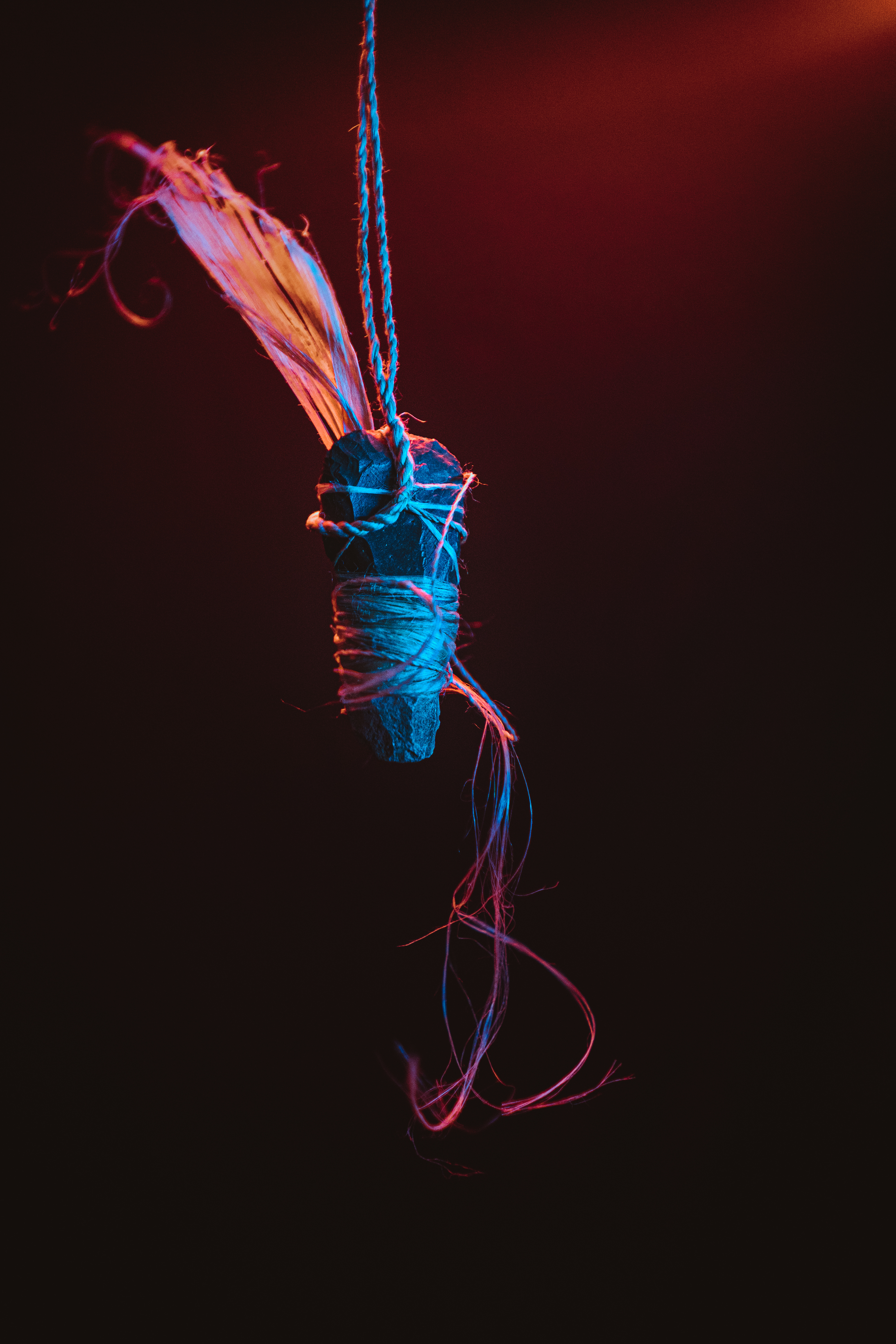
One of the traditions that has interested me most is hemp production. As I mentioned before, hemp has a profound meaning in Japanese culture, and the way it is grown and processed is highly distinctive, both for making thread and fabric and for making rope. Learning to make rope by hand has been an incredibly rich experience, and reflecting on its material and utilitarian meaning has taught me a lot about its essence, giving me clues about the source of its power.
From there, I explored the origins of rope in prehistoric Japan. The Jōmon period lasted roughly 15,000 years (some scholars place it as early as 16,000 BC, others around 13,000 BC). Did you know that the word Jōmon literally means “rope culture”? It was named for the decorative use of rope on pottery. Many of these vessels have humanoid forms (dogū), their small clay bodies marked with bindings.
This image makes me think of ancient rituals in which rope played a central role, the same rope that was later used in a proto-Shinto practice to mark the cave where the goddess Amaterasu hid. This was before the Yamato period, before the introduction of rice and agriculture, when humans lived in the world as children live within their mother. It is an image that is pure fantasy, something we will never truly know, and yet it is there, clear as day.
To finish, what are your plans for this year?
Last year was a milestone for UNBOUND. We created the largest event we have ever done, at Womb, Tokyo’s most important club, in collaboration with Hajime Kinoko and more than forty artists. That means the bar is set very high for this year. We will see what happens, and we will not know until the day comes. We also want to publish a magazine to celebrate all the artists who have made this possible. We have no idea where to start, so I hope the team at MA can give us some advice.
In general, I think this will be a more introspective year. Ai is dedicating a lot of time and passion to creating costumes, which is very important to us when performing. I expect a lot of innovation. As for me, I always say this, but I would like to write more. Thanks to you, that has already happened, and in my native language. It is not just an opportunity, but a gift. If your readers would like to know more about our work, I invite them to visit my blog, where I go deeper into some of the topics we have discussed.
Thank you so much for your time and for sharing more about the essence behind Pablo Shibari. We look forward to continuing this conversation in the MA Magazine podcast. We cannot wait to welcome you to Latin America.
It has been a real pleasure. Best of luck with such a beautiful project. I have never had the opportunity to visit Latin America, and I admit I am a little afraid, because I have the feeling that once I go, I will never want to leave.
If you enjoyed this interview, consider purchasing a digital copy of MA magazine to support their passionate and talented creators! The magazine includes topics on Asian culture, design, architecture, and cinematography.
They also have a podcast (in Spanish) where they go into details on the topics covered in the publication.
As always, thank you for your attention,
Pablo