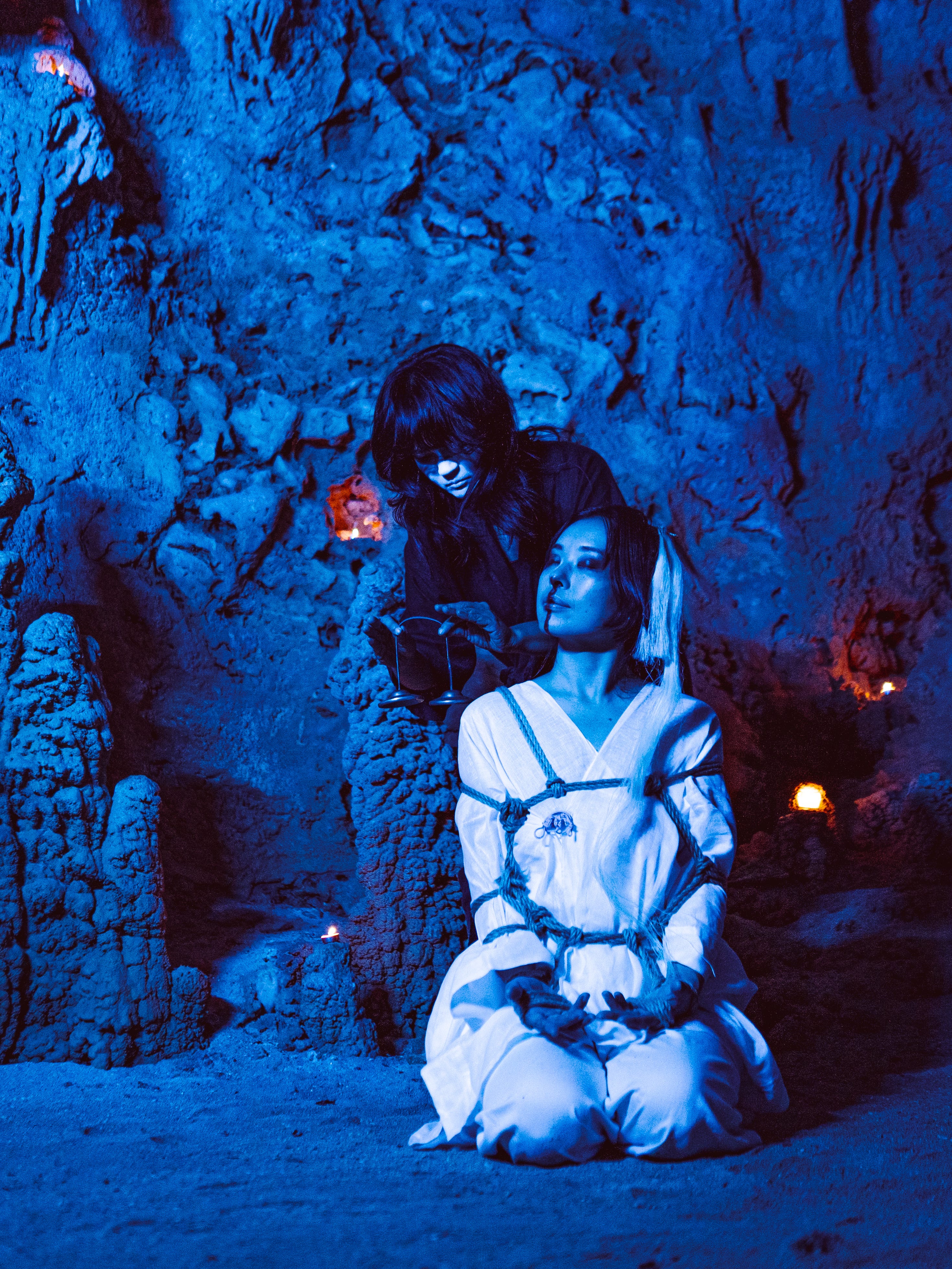
This week I continue to think about integration. I thought I would stay away from water a bit more. I have a post in mind on water and purification that I continue to postpone. Water and purification, water and indigo, indigo and love. It is a hard one to write and I’ve been thinking about it for months. I thought integration was an easier topic, and then I found myself in the water again. Water like a cave with the shape of a tree.
I guess the end of spring is a good time to think about integration. Flowers fall and the humid warmth of the air makes you want to lie down and think about your mistakes, like, deciding to live in a city with such a horrible summer. By the way, this year it is promising, they even invented a new word1.
Jokes aside, maybe it is the Almighty Algorithm or maybe it is my brain doing its thing recognizing patterns, but everyone around me seems to be thinking about the same ideas. What happens after? After the bloom, after the trip, after the revelation.
Seeing something is not discovering it
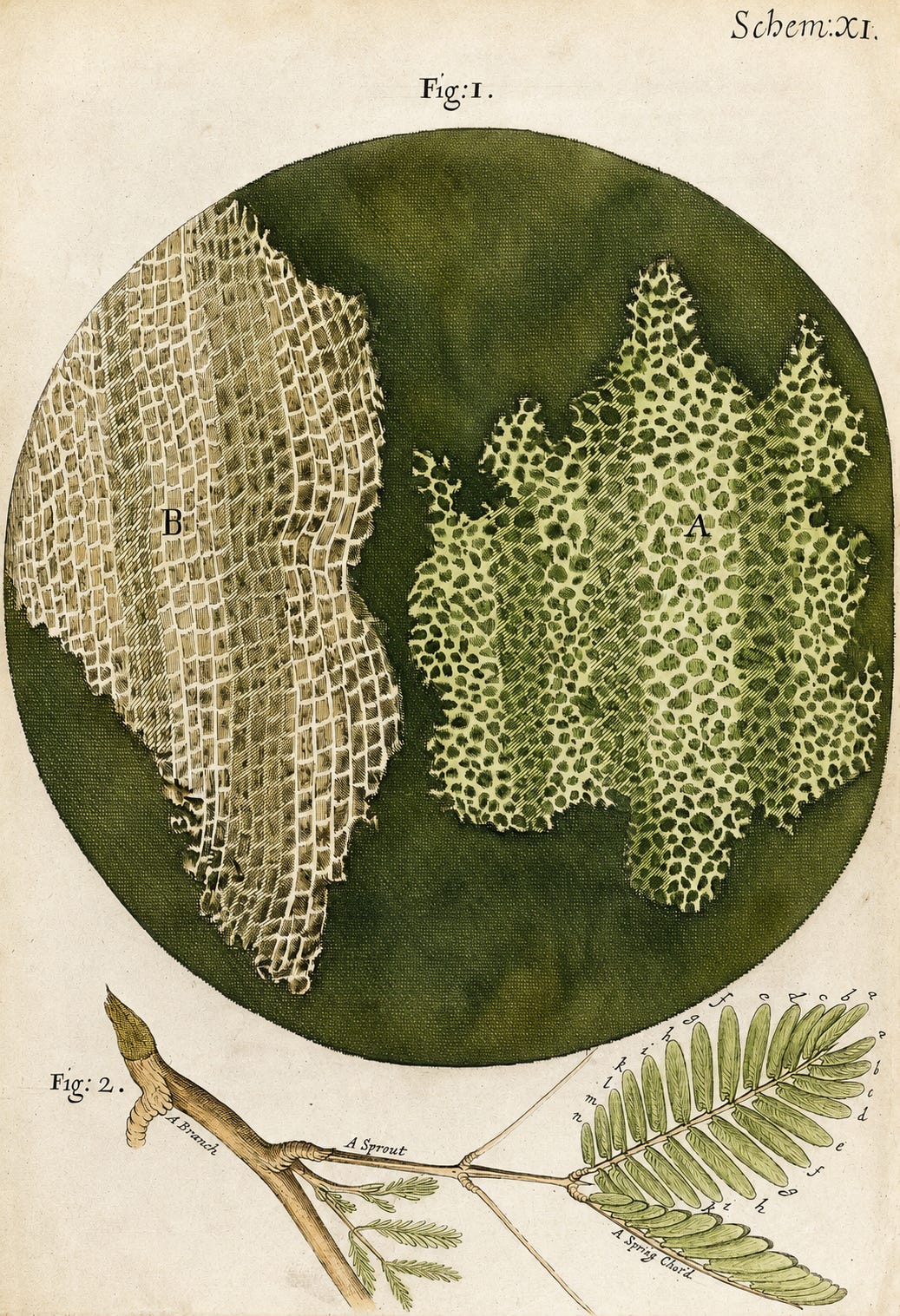
I want to start with a story from Robert Hooke, a brilliant scientist from the seventeenth century, who, among other achievements, is credited to have discovered the cell, a term he coined.
Motivated by the advances in optics, and as part of his work in the Royal Society, Hooke designed a microscope to explore the invisible world around us. A search for the microcosmos the philosophers of the Renaissance had thought about. He collected multiple objects, insects, plants, and rocks, and saw them from an angle no one had seen before.
I think for a scientist there is no better peak experience. Imagine working for years on an instrument and finally making it work. Imagine seeing things you have only dreamed about. A world yet to be named. I would say he was fascinated. That he could not get enough of it. Since I am a father, I may even say that he was hooked.
But somehow the experience did not finish there. He had to put down the magic lenses and go face the unforgiving coldness of a blank notebook. Had he stayed admiring his visions, the cell would not have been discovered. Seeing something is not discovering it. The peak is just the beginning.

An instant of our inner life that dissolves like a dream, that fades like an image no one has seen in the lens of an strange instrument. Only if we bring this into a language, into a metaphor that can be shared with others, can it become part of something, can it become to exist.
It doesn’t have to be words. It can be a language of objects, a totem, a sign that points to a symbol. But it must be something other than what was lived. Something to survive our psychedelic memory.
Integration is not understanding
Humans are symbolic creatures. Living a fulfilling life is to live a life of meaning. A life that can be put in relationship with something else, that makes sense.
This doesn’t necessarily mean that we need to understand it. I don’t mean to say that we have to connect what happens to a cause, as if everything was the effect of a decision that we or someone else had taken. I don’t mean to say that the world makes sense in that universal way. Maybe it does, maybe it doesn’t.
But we can surround our experience with a layer of meaning without having to explain it. To explain it, to make something flat. When Hooke gave meaning to the vision he had, he did precisely the opposite. He added texture to it, layer by layer. He didn’t make a plain but a mountain.
A few years ago I was diagnosed with ulcerative colitis. It sucks, I was sick for a long time and could not eat normally. Nobody knows why it happens, I mean, they say it is autoimmune, which is today’s word for black magic. I visited different doctors and each of them prescribed different medicines, each worse than the other. I was annoyed. Annoyed by the sickness and annoyed because I had the sickness. I didn’t feel well, and I did not accept it.
I wanted to understand it. I knew that some food made me sick, but I didn’t know why. I could trace the mechanism, like, I could hear from a doctor that my gut mobility is reduced, that it spirals up into the rest of my digestive system, and it makes me feel nauseous. The intestine linen, the gut macro biota… At some point I was following a diet called GAPS that is supposed to help you find a baseline, help you find causes. Except that I didn’t have a baseline. The more I looked for the reason, the worse I felt. At some point even a harmless apple was under the bar.
Now the years have passed. I am still sick but now I am used to it. I can say I eat normally, but only because my definition of normal has changed. And I have changed myself. I see my body in a more gentle way. I see the food I cannot eat without desire, and I see my body from a much closer distance, not with disdain but with compassion.
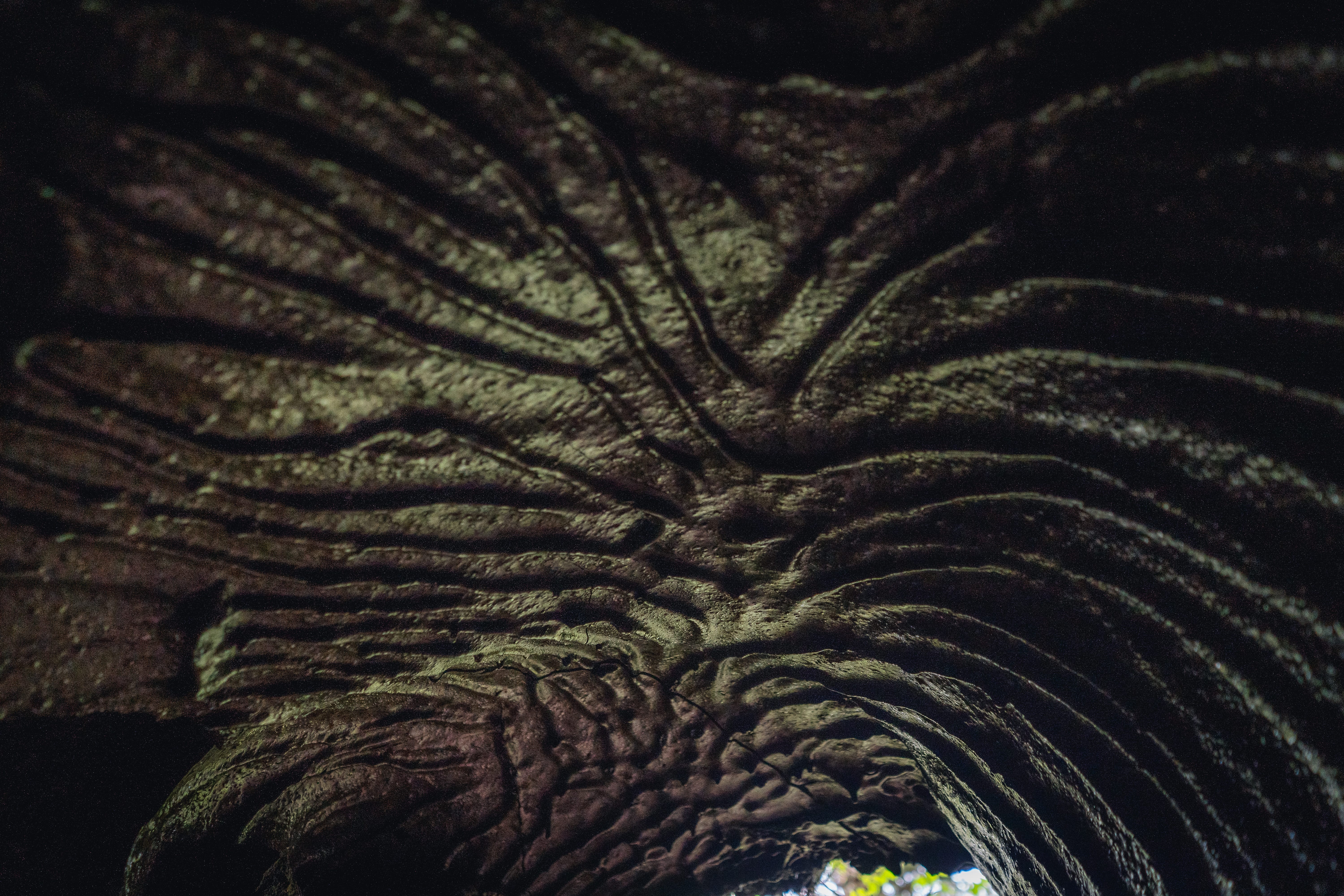
Recently I went to a cave inside Mt. Fuji2 and I saw the walls like a giant intestine. I will talk about this experience in detail as part of the series around MUSUBI. But what I want to say now is that looking at those walls I felt compassion. I realized in a very visual way that the way I relate to my intestine is completely different. I guess for most people if they think about the intestine they think about feces, they think about half digested food, fermented gas, bad smell. I used to feel like this. But this time I felt tender, inside the most delicate part of something.
Integration is not progress
This story may sound like there was an evolution. Pablo was sick and then he was not sick. He chilled out, accepted himself, he cured himself magically.
That would be amazing. I would stop doing ropes and become a gut healer. Except that I still have ulcerative colitis.
But if nothing has changed, what has changed?
I was thinking about this question for a while.
And the water came back.
We all have up and downs. In Japanese you say 波がはげし, the waves are violent. A powerful sentence that reminds you that you have no control. When I was younger I wrote often letters to myself, sort of spells, words of encouragement that I would read when I was at the bottom. I didn’t speak Japanese. I thought I could control such waves.
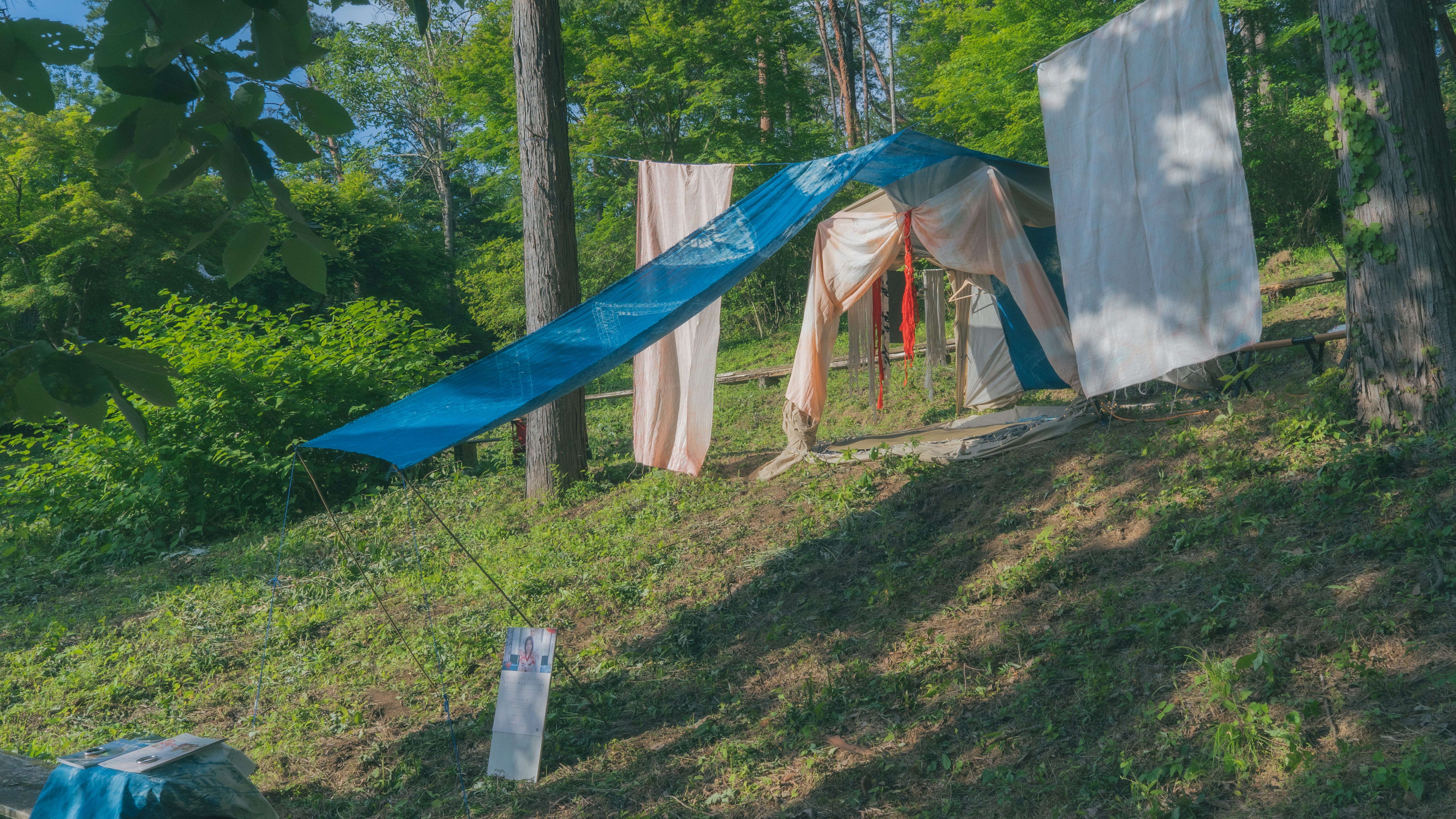
Last weekend I went to Tochigi for an event in the mountain with friends. We were doing a booth to talk about our work. My wife did a beautiful performance with LEDs. I was with my daughter. My best friend was visiting from abroad with his lovely girlfriend. Everything was perfect.
But to be honest I was feeling really bad. I don’t know. 波がはげし. I could not understand it then and I don’t mean to understand it now.
At the end of the weekend we went to the hot spring. My body was tired, Sunday night, still two hours drive away from home. The water was very hot. I was melting.
I saw two friends coming. They washed themselves and came into the water.
Ahhhh… saikoo3!
They melted too. If you have been to an Onsen, you know the feeling.
“The first dive is the best” - one of them said. I could see their red faces in absolute bliss.
“If you go out and splash cold water” - said the other one - “it is like the first time again”.
Ah the first time again… The absolute dream. Looking at the cork holes before they had a name.
I was not in the mood for an experiment, I was busy dissolving in my misery.
But they were. They went outside and splashed cold water.
Ahhhh… saiaku!4
And came back inside again
Ahhhh… saikoo!
A simple cycle, waves are sometimes sweet.
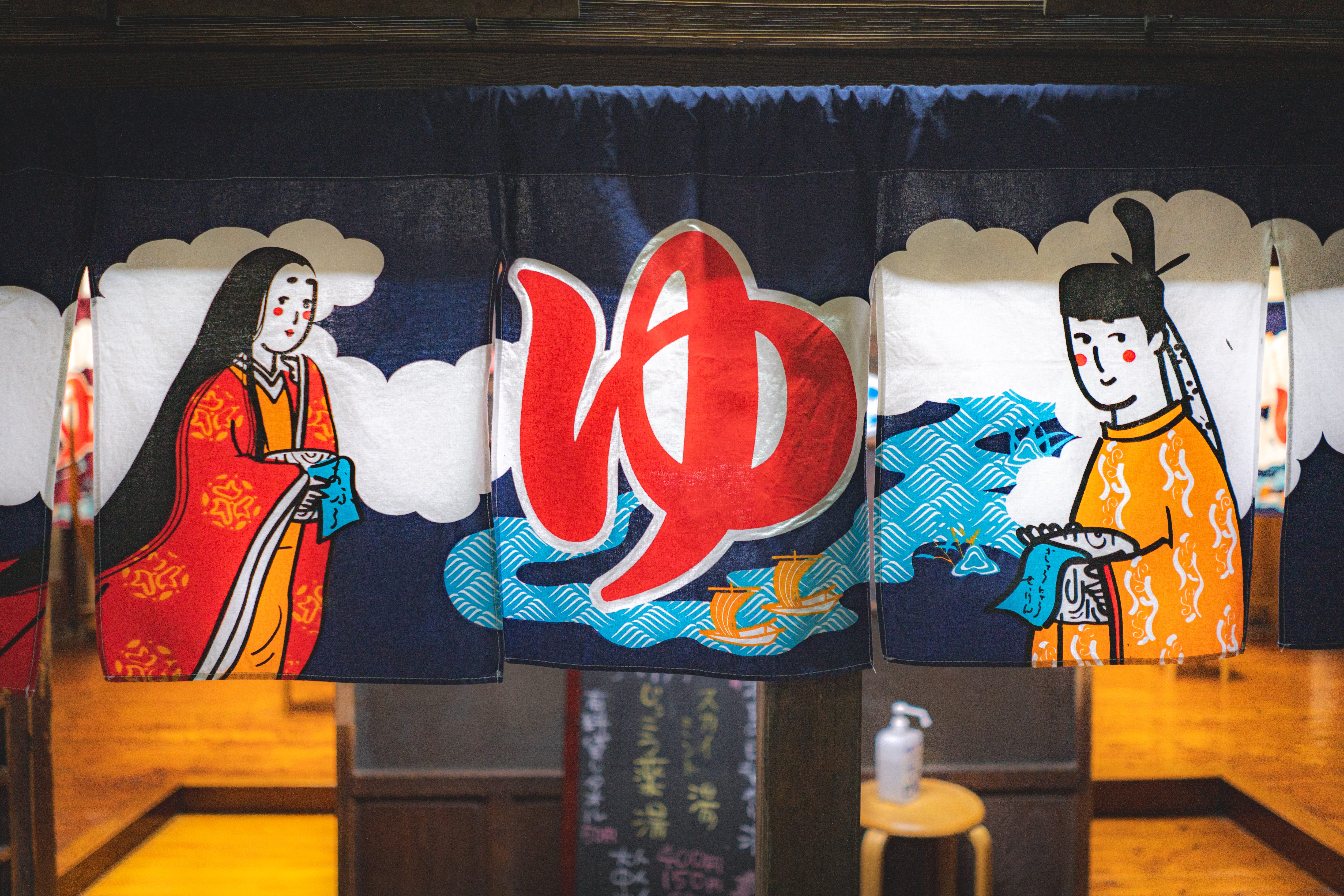
To be honest I love cold water. One of my favorite things to do is to go into the sauna and then do breathing exercises in the cold bath. Every single time I remember Wim Hof wise words “don’t do this in the pool” as I hold my breath half submerged. If I die, you know how it happened.
I left the bath and went to the shower. I didn’t go to prepare my body for the hot water again. I was just craving the sharp bliss of cold.
And the cold provided. I must say, for the first time in the weekend I felt good. My head disappeared.
But soon enough it came back, the high vanished. Intuitively, I thought I had to go back to the bath again, to get warm so I could enjoy the cold.
Oh but now... The hot water welcomed me, almost like the first time, I mean, like the real first time. Not like the actual first time when I was just grumpy thinking about how grumpy I was.
Which one is which?
Do we get hot so we can get cold? Or do we get cold so we can get hot?
It all dissolves into nothing.
It all integrates into everything.
You don’t need an explanation to change your mind.
You don’t need a story.
Maybe you don’t even need to change your mind.
湯の名残
今宵は肌の
寒からん
— 松尾芭蕉
The warmth of the bath remains.
Tonight, my skin
will feel the cold.
— Matsuo Basho
Thank you for reading Rope Meditations,
Pablo Aida
酷暑日, kokushobi, or cruelly hot, reserved for days over 40 degrees Celsius. Like Chekhov’s gun, but for the weather forecast.
胎内樹型, Tainai Jukei, literally means ¨inside the womb¨ and ¨tree cast¨. A strange geological formation that actually does justice to its name. These caves were made when lava flowed over trees, and solidified before the trees burned away. After the trees disappeared, the shape got casted into the rock. The texture of the tree is perfectly printed in the walls, giving it a very organic feeling that resembles the inside of a living creature.
最高, Saiko. The best, awesome. A common expression.
最悪, Saiaku. The best, awesome. A common expression.