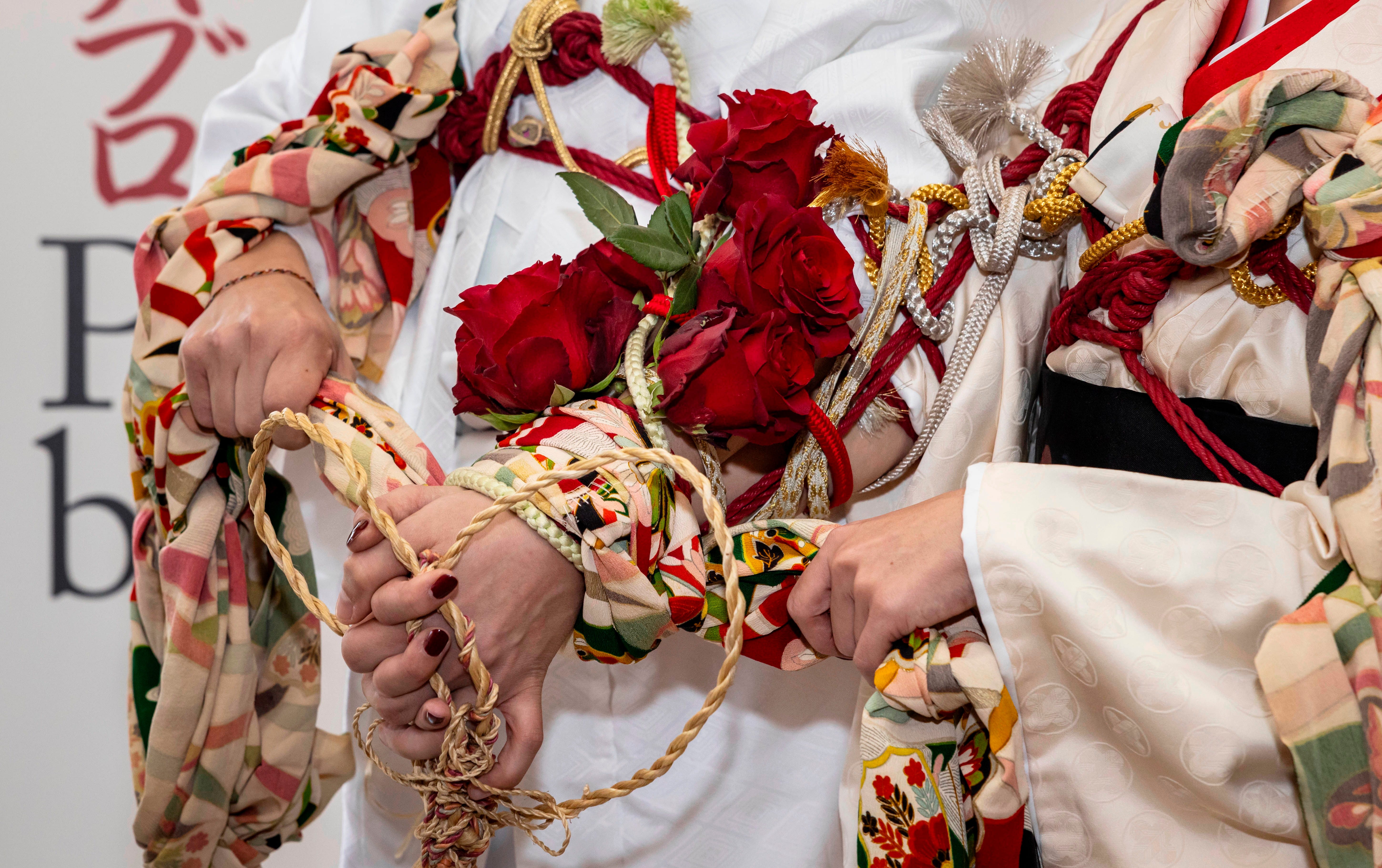
The year of the snake was packed with encounters and events that triggered the germination of something that has been trying to sprout in me for years, as if it were planted in rocky soil. Something rooted at the core of my work, I would say, at the core of my identity. I will talk about three moments that took place in three different countries.
What’s in a name?
In November of last year I traveled to Italy, and I was fortunate enough to visit the beautiful Yugen studio, where I attended a two-day workshop on the experience of being tied. I heard from my friend Manami that Yugen was big and “well done”, but still what I saw surprised me: I cannot say it felt like a portal to Japan, because honestly I haven’t seen a studio like that in Japan. Tall ceilings, wooden columns, wide tatami, natural light, walls decorated with signed artworks and infographics. A professionally designed space for the craft and the community.
But of course it is not about the space. Attending the workshop, getting to know the participants coming from all over the globe, and talking with the always gentle and knowledgeable Marta and Federico (the minds and hands behind Yugen), left a deep impression on me.
Among the encounters I had, there was one in particular that I must highlight. The night before the workshop started, over a casual dinner, I met Tanja, the co-owner of Kinbaku Lounge in Denmark. We had a fascinating conversation. Tanja has a long experience in ropes, and you can tell she has put a lot of thought into what she does.
I told her I was coming from Tokyo, where I have a tiny studio, and we talked about our practices, our journeys, and about the differences between Japan and Europe, between Shibari and Kinbaku.
This is a loaded topic for me. I am a Spanish person who has lived most of his adult life in Japan, a country where identity is never a neutral question. And here, I don’t fully identify with the values and aesthetic of traditional Kinbaku: of power balance, of shame and punishment, of raw, yet miraculously refined, dark eroticism.
One could argue that Shibari is an umbrella from which Kinbaku is a subcategory. It makes sense linguistically, and it is convenient. But as Tanja and I were talking in Milan, it is unfortunately not historically accurate. And it is also part of how, in the western world, some people try to “wash away” the SM imagery.
You could say I am one of those people, except I am in Japan.
Talking with Tanja I realized that for many years I have been trying to legitimize my vision in a history that I know doesn’t exist. I think I have always been honest with the roots I draw from, which are related to the symbols of Shinto (hemp, shimenawa, kekkai…), the phenomenology of Buddhism (mushin, sunyata, rebirth…), and the science of altered states of mind and psychedelics.
What I realized just there is that maybe that is not Shibari. And that is ok, it doesn’t have to be.
But what does it say about me: Pablo Shibari?
I am so afraid of people’s words… they hush and stand still. That’s how you kill.
Rainer Maria Rilke
Names are complicated, but proper nouns are a kind of violence. I never liked Pablo Shibari. When I started Instagram in 2019 it was just a handle, using the words of my teacher. It was not my name.
But later on I started to write it in more places: in the flyers of my performances, in the website of my studio, in my blog, in my business cards. What started as a label was slowly becoming an identity.
For many years I knew I had to change it. I thought it was somehow lame, but in Milan I realized it may also have been wrong.
The debate of Kinbaku and Shibari is fascinating, but I don’t need to carry it in my name. I don’t need it to be resolved in order to continue growing.
Musubi
The second part of this germination in three acts took place in Japan, with my snaky friend Sayako Shiratori. Sayako and I have collaborated many times over the years, from performances to art pieces, but we had never shared a session together, a space to shed our old skins.
And I don’t mean to say that performances are somehow less real than sessions. A performance, at its best, is also an act of creation, not the repetition of something already known.
But the movement is different. Performances open outward. Sessions, inward.
Sayako is one of the most insightful rope artists I know, so when she asked me, I was nervous. What would she, the mother of the snakes, feel about what I do?
The session came and went, as they always do, in an instant outside of time. Afterwards, Sayako told me that rope is like two snakes mating, stretched into a spiral coil. She said she saw the coil turning into a dragon. She spoke of love, of synchronized breathing, of Fudō Myōō who torments and rescues through rope, of Shiva as the god of destruction and rebirth.
And then she said something simple that I remember clearly: although our practices are different, they share the same origin and the same destination.
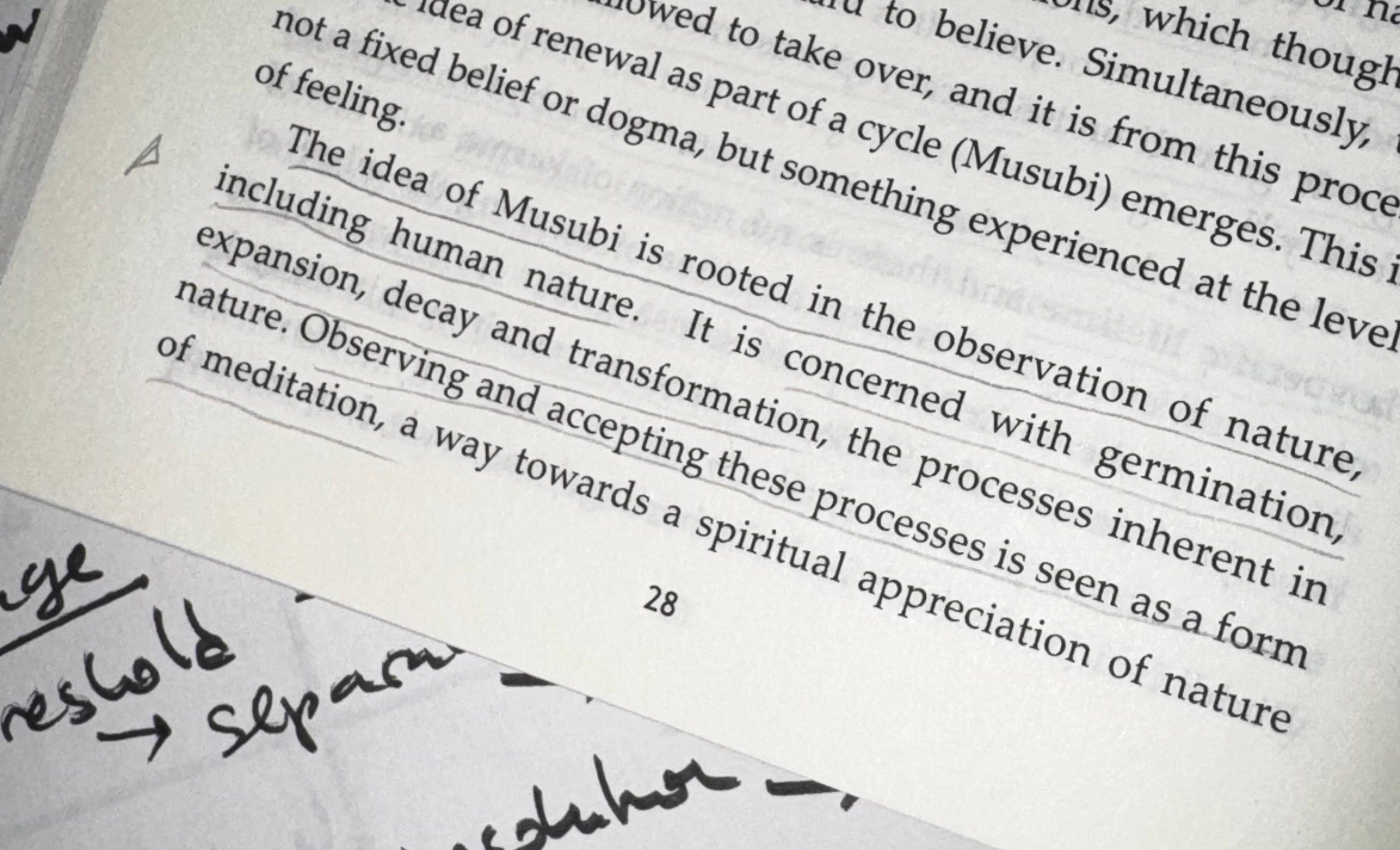
Sayako does not call what she does Shibari, but Musubi (結び). Musubi means to tie, but also to connect. It echoes Musubi (産霊), the life force of growth and becoming.
Perhaps this is the third way. Not a solution to the puzzle of Shibari and Kinbaku, but a step aside from it: a space where the question stops being about terminology and returns to the body, to practice, to what is actually lived.
All I have learned about ropes, I learned through my body. In fact, I learned about my body itself thanks to the ropes: how it expands beyond myself, and how it contracts much deeper than thoughts ever could. It has a wisdom that before I had felt only through poetry, a wisdom beneath concepts, revealed in the pulse of co-creation.
For some time now I have wanted to organize an event that feels intimate, that opens this conversation in a way that UNBOUND, with its raw and unstoppable energy, could not. An event that is mostly a meeting point: a forum to discuss, or rather, to live these ideas together.
And now Sayako, Ai, and I are starting a new project that we will call, precisely, MUSUBI.
Language as a performance
The last seed of the year sprouted in the country where it all started, at least for me: Spain.
We were heading there to celebrate a wedding that, in a sense, had already happened years ago, the wedding of Ai and me.
And yet, it had not quite happened.
We had signed the papers, of course. We had been living as a family, and we even have a four-year-old daughter. But we had never officiated it. We had never spoken it into being, in front of others, in a ceremony.
Here, celebration and performance share a similar ambiguity. Was the wedding four years ago, and now we were merely showing that we are married? Or was the wedding now, in the moment we finally enacted it, performed it, pronounced it?
I found myself thinking that perhaps certain events do not fully exist until they are spoken. Not because the words are more real than life, but because language, in rare occasions, is not description. It is action.
I won’t say much here about our wedding, other than it contained ropes and words.
I asked Sayako about my name, who was with us to officiate our union. Who better advise me on such a defining occasion? It was now clear.
And the last seed of the snake revealed itself. There was only one: a dream to wake up to, a name to be called, a horse to be ridden.
Thank you for your attention,
Pablo Aida