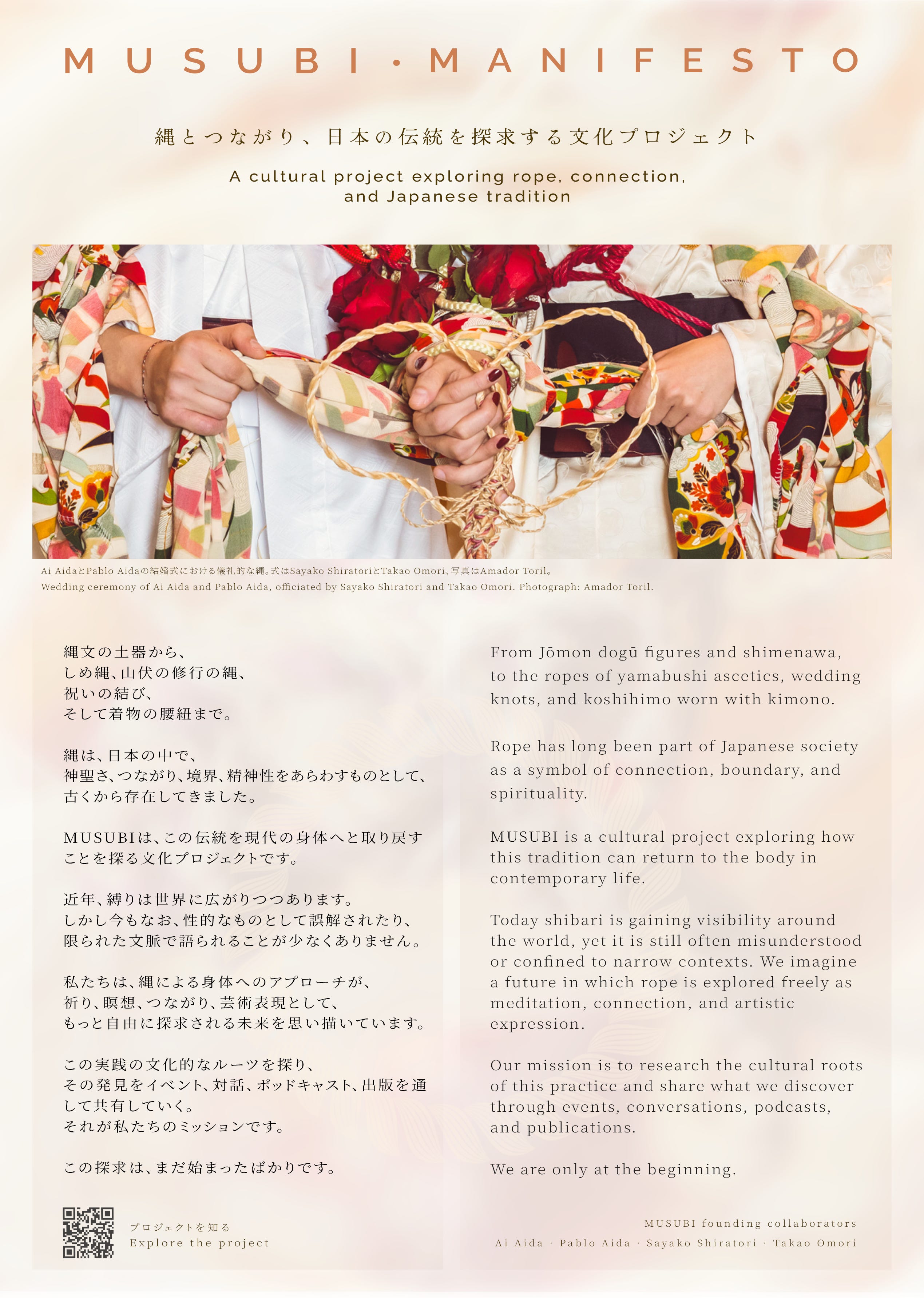
From Jōmon dogū figures and shimenawa, to the ropes of yamabushi ascetics, wedding knots, and koshihimo worn with kimono.
Rope has long been part of Japanese society as a symbol of connection, boundary, and spirituality.
MUSUBI is a cultural project exploring how this tradition can return to the body in contemporary life.
Today shibari is gaining visibility around the world, yet it is still often misunderstood or confined to narrow contexts. We imagine a future in which rope is explored freely as meditation, connection, and artistic expression.
Our mission is to research the cultural roots of this practice and share what we discover through events, conversations, podcasts, and publications.
We are only at the beginning.
Ai Aida · Pablo Aida · Sayako Shiratori · Takao Omori
It is a small text, but for us it marks the beginning of something important. Not a conclusion, and not a fixed definition, but an attempt to give words to a shared intuition. A way of saying that rope belongs to a wider field of culture, body, and art.
Return to the body
For some time now, we have felt the need for a different language around rope. One that can hold its cultural roots, its artistic possibilities, and its power as a living practice between people. MUSUBI was born from that need. From the desire to return rope to the body, to relationship, and to culture. To open a space where it can be approached more openly, in dialogue with other living traditions that inhabit the same ground.
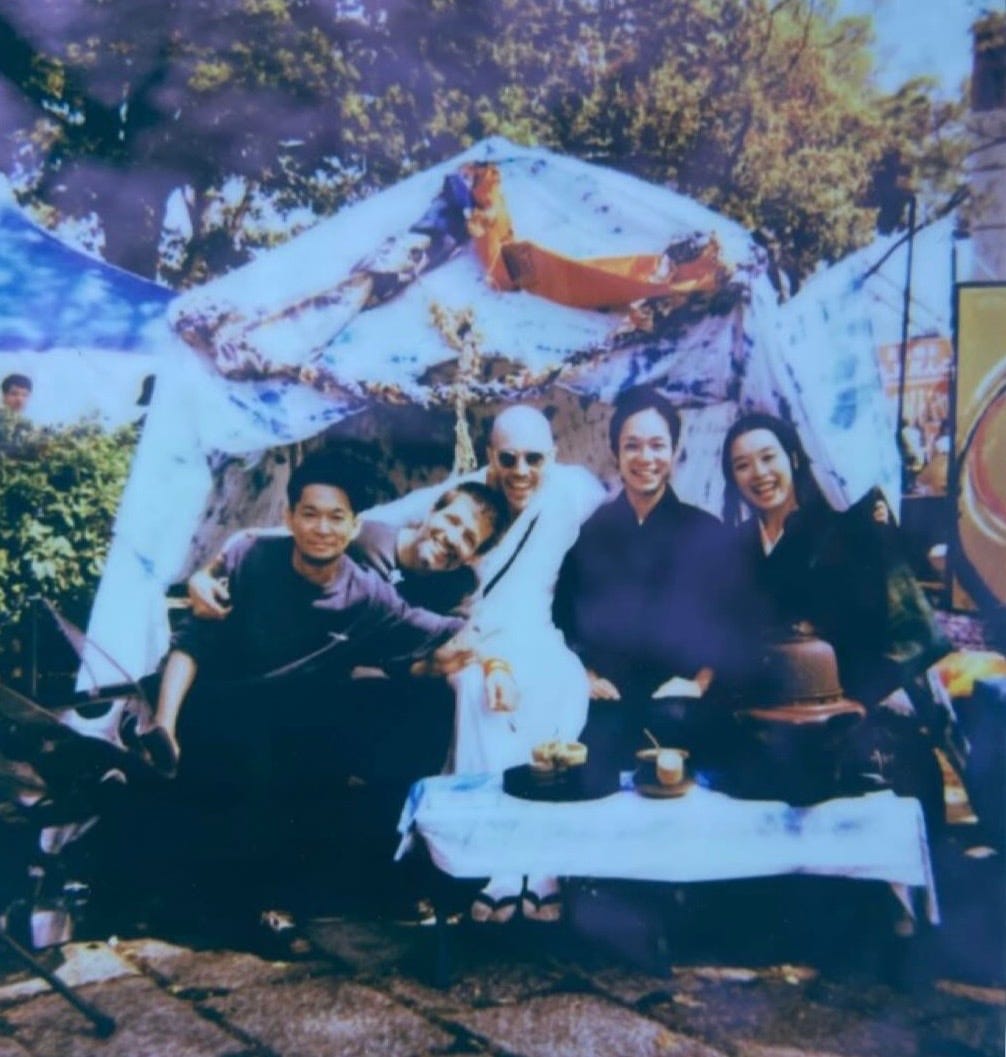
Harukaze felt like the right place to bring it into the world.
A celebration of life at the beginning of spring, in the heart of Tokyo, in Yoyogi Park, beside Meiji Jingu, the spiritual center of modern Japan.
We organized a booth to speak about the work. Ai also released her new brand, AIAIDA Textiles. And together with Sayako and Takao, we placed the manifesto into people’s hands for the first time.
But more than that, what stayed with me was the feeling of the weekend itself. After months immersed in my inner world, I was suddenly surrounded by the people closest to me. A friend visiting from Spain told me he was struck by how open everyone was, and by how naturally people seemed to know one another. I kept thinking that this is what community means. Not simply that people know each other, but that a certain sensibility brings them together. If you are there, chances are something in you already resonates with someone I care about deeply. And that creates an immediate sense of closeness.
And that is what all of this is about. We can think endlessly about concepts and meanings, but culture is made by people and by the ways they live, meet, and create together. There is a thread, like an invisible rope, that draws us toward one another. In a world that constantly pulls us into opposition, most of us are longing for the same things: to dance, to laugh, to make something beautiful.
A body of inquiry
We are at the beginning, and new paths are emerging like water from the ground. We are researching the roots of hemp (we visited a farm!), the yamabushi and Shugendō, and the immediate experience of those who enter the ropes.
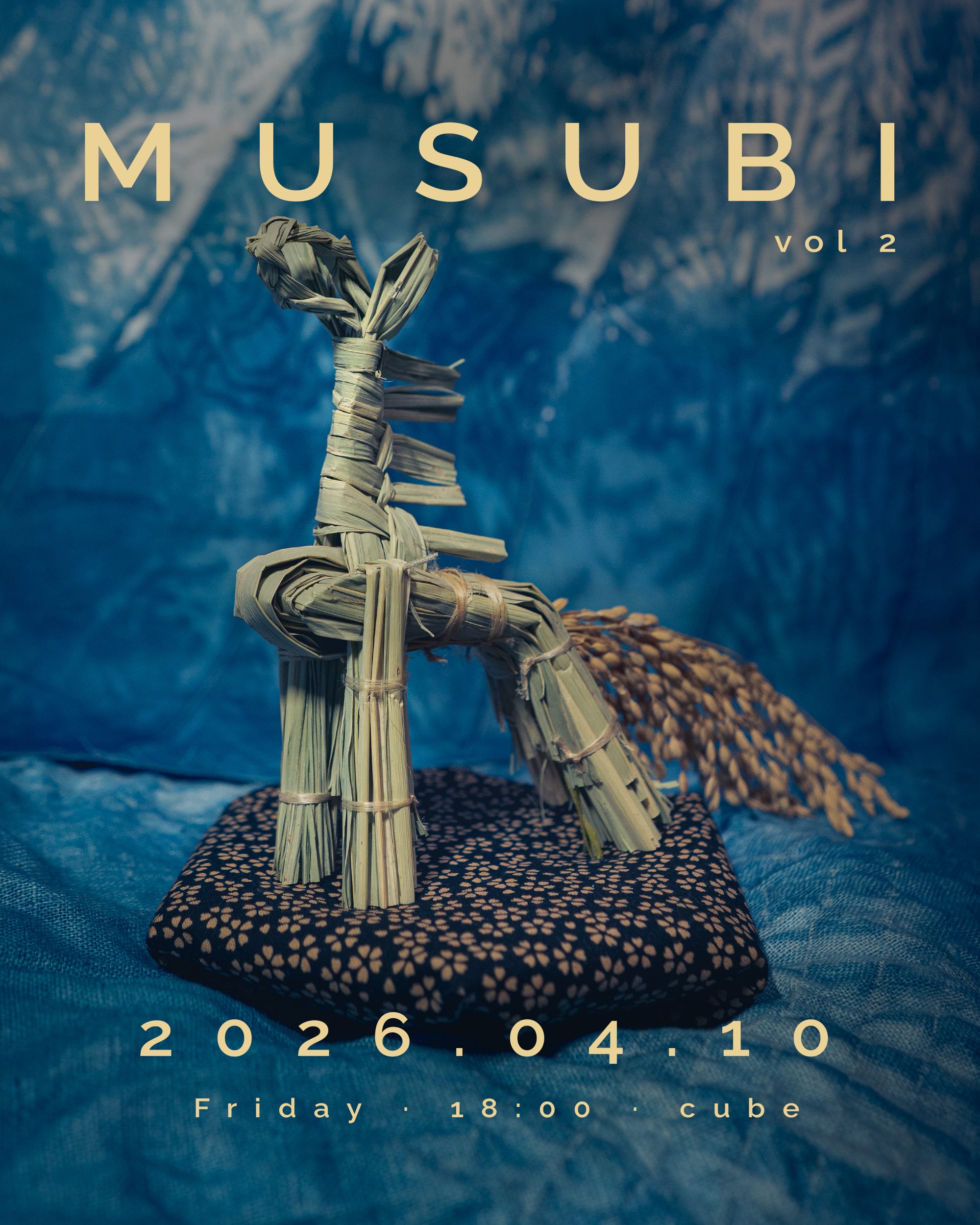
If you are in Tokyo, we have started a monthly gathering to hold these conversations in person, and we will be sharing the journey through a podcast and a magazine. If you are elsewhere, give us a little more time while we prepare what comes next.
In the meantime, what does “return to the body” mean to you?